
UC272 Extractant
UC272 is an acidic organophosphorus extractant; other members of this class include P204 and P507. P204 is widely used for the extraction of zinc, iron, manganese, and other elements, primarily in the early stages of smelting ternary precursor materials to remove impurities. P507 is mainly employed for the extraction and separation of nickel and cobalt as well as for the smelting of rare-earth elements; it is the most important acidic extractant and currently serves as the primary extractant in the industrial production of battery-grade cobalt sulfate and the enrichment and separation of light rare-earth elements. As an upgraded version of P507, UC272 boasts a nickel–cobalt separation factor of 7,000, significantly higher than that of P507 (280) and P204 (14). It is extensively used in the production of battery-grade nickel sulfate and battery-grade manganese sulfate and is a widely adopted extractant in the manufacturing of ternary battery materials. Moreover, compared with P204 and P507, UC272 requires a lower extraction acidity, is easier to back-extract, and exhibits excellent selectivity toward rare earths—particularly heavy rare earths. Consequently, its application has expanded from nickel–cobalt separation to the extraction and separation of rare earths, thereby driving rapid development in the rare-earth industry.
Classification:
Key words:
UC272 Extractant
Key words:
Description
Excellent Selection 272 Product Manual
Basic Information :
product Name
|
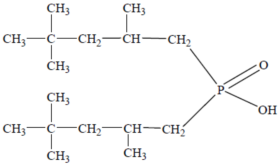
double (2,4,4- Trimethylpentyl ) Phosphonic acid C272
|
Chinese Academy of Sciences Number
|
83411-71-6 |
Molecular formula
|
C 16 H 35 O 2 P |
Molecular weight
|
290.43
|
Purity
|
≥ 99.0%
|
Structural formula
|
|
Uses
|
Hydrometallurgical Extractant
|
Transportation
|
Handle with care, avoid impacts, and keep away from open flames.
|
Storage
|
Store in a cool, well-ventilated, and dry warehouse; ensure protection against water and rain.
|
Physicochemical properties:
Appearance
|
Colorless liquid
|
Density ( 25°C )
|
0.92 – 0.93 g/mL |
Viscosity ( 25°C )
|
less than or equal to 180 cP s |
Viscosity ( 50°C )
|
less than or equal to 60 cPs |
Solubility in distilled water ( pH 2.6 )
|
less than or equal to 16 mg/L |
Solubility in distilled water ( pH 3.7 )
|
less than or equal to 40 mg/L |
Flash point (Closed Cup)
|
≥ 13 0°C |
Boiling point ( 760 mmHg )
|
≥ 300℃
|
Pour point
|
≤ -20℃
|
Specific heat ( 52°C )
|
2.370 J/ g·K
|
Thermal conductivity (room temperature)
|
0.168 W/m ·K
|
Extraction Performance :
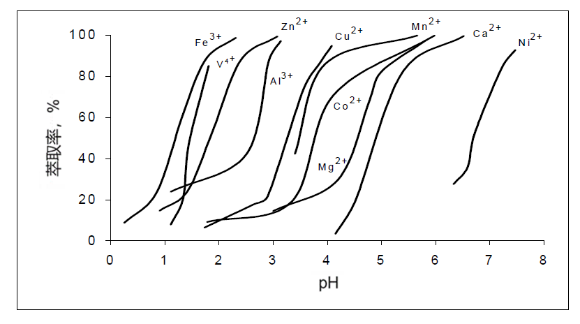
Metal extraction sequence ( 0.6 M Excellent Selection 272 , Diluent: D80, 0.015 M of M n+ ,40 °C, sulfate medium, O/A = 1.0 , Contact time: 5 min )
Characteristics of non-calcium extract :

When cobalt and calcium are present in the feed solution simultaneously, Youcui 272 Extracting cobalt before calcium can prevent gypsum scaling in sulfuric acid-based extraction systems, reduce emulsification, and thereby minimize solvent loss; whereas, in the same system, using P 204 and P 507 As an extractant, it first extracts calcium and then cobalt; however, the separation of cobalt from calcium is poor, and back-extraction readily leads to scaling.
Performance Parameters and Nickel-Cobalt Separation Factor
Extraction rate
|
≥ 98%
|
Back-extraction rate
|
≥ 98%
|
Nickel-cobalt separation factor
|
7000
|
Phase separation time
|
≤ 180 s
|
Operating temperature range
|
40 – 60℃ |
Maximum applicable concentration
|
50% (v/o) |
Main applications:
Function
|
Application Fields
|
Advantages
|
Nickel-cobalt separation
|
Laterite nickel ore
|
It exhibits a high separation factor, is resistant to calcium scale formation, requires fewer extraction stages, consumes less reagent, and yields a product of high purity.
|
Heavy Rare Earth Separation
|
Southern Heavy Rare Earth
|
High separation factor, low back-extraction acidity, fewer extraction stages, and low acid consumption.
|
Lithium-magnesium separation
|
Lithium extraction from salt lakes
Secondary Lithium-Ion Battery Recycling
|
The extraction efficiency for magnesium is significantly higher than that of conventional organophosphorus extractants. P204 and P507 , used for the deep removal of magnesium from lithium.
|
Nickel-magnesium separation
|
Secondary Lithium-Ion Battery Recycling
Waste Catalyst Recovery
|
High separation factor
|
Cobalt-iron separation
|
Secondary Lithium-Ion Battery Recycling
Waste Catalyst Recovery
|
Under lower acidity Fe 3+ It has a high extraction rate and is superior to P204 and P507 Easy back-extraction.
|
Nickel-iron separation
|
Secondary Lithium-Ion Battery Recycling
Waste Catalyst Recovery
|
Under lower acidity Fe 3+ It has a high extraction rate and is superior to P204 and P507 Easy back-extraction.
|
User Notice:
Before use, users are required to read this manual carefully. By using the product, users are deemed to have acknowledged and accepted all its contents. Users must comply with the product instructions as well as applicable laws, regulations, and policies when using the product. The product usage instructions and formulation guidelines are provided for reference only. During product use, users are responsible for conducting their own tests prior to application to ensure that the product meets their expectations and process requirements; the product may be used only after such tests confirm compliance. Users undertake to assume full responsibility for their actions and all resulting consequences. The company shall not be liable for any losses arising from improper use or failure to observe the specific requirements of the conditions of use.
Previous
Previous
Message
Please describe in detail the questions you need to consult, and we will arrange personnel to contact you in time.
Related Products

UC272 is an acidic organophosphorus extractant; other members of this class include P204 and P507. P204 is widely used for the extraction of zinc, iron, manganese, and other elements, primarily in the early stages of smelting ternary precursor materials to remove impurities. P507 is mainly employed for the extraction and separation of nickel and cobalt as well as for the smelting of rare-earth elements; it is the most important acidic extractant and currently serves as the primary extractant in the industrial production of battery-grade cobalt sulfate and the enrichment and separation of light rare-earth elements. As an upgraded version of P507, UC272 boasts a nickel–cobalt separation factor of 7,000, significantly higher than that of P507 (280) and P204 (14). It is extensively used in the production of battery-grade nickel sulfate and battery-grade manganese sulfate and is a widely adopted extractant in the manufacturing of ternary battery materials. Moreover, compared with P204 and P507, UC272 requires a lower extraction acidity, is easier to back-extract, and exhibits excellent selectivity toward rare earths—particularly heavy rare earths. Consequently, its application has expanded from nickel–cobalt separation to the extraction and separation of rare earths, thereby driving rapid development in the rare-earth industry.
Youcui 811 Nickel-Cobalt-Manganese Co-Extraction Agent
Youcui 811 is a modified organic-acid-based extractant whose selectivity for the separation of Ni²⁺, Co²⁺, and Mn²⁺ from Mg²⁺ is markedly superior to that of P204, P507, and C272, making it highly promising for applications in lithium-ion battery recycling and in the hydrometallurgical extraction, separation, and purification of nickel and cobalt.
Youcui 098 Rubidium-Cesium Extractant (t-BAMBP)
Rubidium and cesium are distinguished by their exceptionally high photoelectric thresholds and extremely low work functions, endowing them with outstanding photoelectric properties. It is precisely these unique physicochemical characteristics that render rubidium and cesium indispensable in aerospace, defense, and other critical applications.
Youcui 936 extractant is primarily used for the extraction of Li under alkaline conditions. <sup>+</sup> , to achieve Li/Na and Li/K separation as well as Li concentration <sup>+</sup> The objective is to achieve the efficient, low-carbon, comprehensive utilization of lithium resources.



Online Message
Products
Contact Us
Company address: District D, Economic Development Zone, Mingxi County, Sanming City, Fujian Province
R & D Center: Floor 3, Building 17, Yard 50, Huatuo Road, Daxing Biomedical Industry Base, Zhongguancun Science Park, Daxing District, Beijing
E-mail:sales@ribio.com
Company Phone:+86+0598-2865298
R&D Center Tel:+86-010-52073088
Mobile
Copyright©2024 Fujian Ribio Technology Co., Ltd.